
Bangalore · Mysore · Ooty
Two principal movements
Roadapprox. 3.5 hrs
Bangalore Mysore
Palace and garden visits can be integrated en route.
Roadapprox. 4 hrs
Mysore Ooty
Climb through forest and the Nilgiri landscape.
Private South India Tours · Private Dossier
Karnataka · Kerala · Tamil Nadu
A long-form journey across three southern states, moving from Karnataka’s palaces and Nilgiri hills through Kerala’s backwaters and highlands into Tamil Nadu’s temple cities and coastal heritage.
Bangalore and Mysore establish Karnataka’s royal and urban character before Ooty introduces the Nilgiri hills and heritage railway. Kerala follows through Cochin, Alleppey, Thekkady and Munnar; Tamil Nadu completes the journey through Madurai, Chettinad, Pondicherry, Kanchipuram and Chennai.
At twenty-two days, pacing becomes the central design question. The itinerary uses several two-night bases and treats rest, laundry, slower mornings and hotel quality as part of the experience. The route is comprehensive without needing to feel relentless.
Two principal movements
Palace and garden visits can be integrated en route.
Climb through forest and the Nilgiri landscape.
Two principal movements
The heritage railway provides the memorable descent from the hills.
Backwater time separates the coast from spice country.
Two principal movements
A scenic highland transfer links spice and tea landscapes.
Cross the Ghats into Tamil temple country.
Two principal movements
Mansion culture and food shape the route north-east.
The final journey returns through silk and temple heritage.
Pacing note for Grand South India Tour Exact flight, rail and road timings are reconfirmed for your travel dates, with weather, permits, altitude and local conditions allowed for where relevant.
Bangalore, Mysore Palace and the Nilgiri transition establish the first chapter.
Use the heritage train to experience the mountain landscape at a different speed.
Cochin, the backwaters, Periyar and Munnar create a complete natural and cultural arc.
Move from cuisine and mansion craft into one of South India’s most intense temple cities.
End with Franco-Tamil heritage, Kanchipuram silk and the Coromandel capital.
For the start of Grand South India Tour, your representative meets you after baggage collection, coordinates the private transfer and assists with hotel check-in. The arrival remains simple, with contact details shared in advance.
As the light softens, the day changes pace. Settle into your hotel and freshen up after your journey. The evening is at leisure — explore the vibrant neighbourhood around your hotel. Bangalore's MG Road and Brigade Road offer excellent dining, shopping and café culture. Enjoy a welcome dinner at one of Bangalore's popular restaurants. Rest and prepare for a full day of sightseeing tomorrow.
For “Arrive Bangalore”, the arrival is deliberately light: assistance, transfer and check-in are handled as one sequence, with no compulsory sightseeing added after the flight.
Overnight: Bangalore
Begin in the cooler morning hours. Meet your driver and guide and begin sightseeing in Bangalore — the "Garden City of India". Lalbagh Botanical Garden, where founder Kempegowda-II built one of the towers to mark the city boundaries — a beautiful, planned pleasure garden originally laid out by Hyder Ali and expanded by Tipu Sultan. The Cantonment area — established by the British after the death of Tipu Sultan — including one of the Old Churches, the Bazaar and the historic residential area.
Later, the focus shifts. After lunch, visit the Palace of Wodeyars (Bangalore Palace) — modelled on Windsor Castle, this magnificent structure tells the fascinating story of the Wodeyar royal family who ruled Bangalore. Cubbon Park, laid out by Lord Cubbon, spread over 300 acres of lush green foliage — home to the Attara Kacheri, Cubbon Park Museum, Sheshadri Iyer Memorial Park and the Bangalore Aquarium (second largest in India). Evening dinner at one of Bangalore's popular restaurants.
For “Bangalore Sightseeing”, the sequence follows light, opening hours and local traffic, prioritising the principal visit while keeping secondary stops adaptable.
Overnight: Bangalore
Stop en route at the historic town of Srirangapatna — once the fortified island capital of Tipu Sultan, the Tiger of Mysore. The Ranganatha Temple — a magnificent Vaishnava temple dedicated to Lord Ranganatha, set on the sacred Kaveri island. Tipu Sultan's Summer Palace (Daria Daulat Bagh) — a stunning example of Indo-Saracenic architecture with exquisite murals depicting the Battle of Pollilur. The Jama Masjid (Mosque) — constructed by Tipu Sultan in 1784, one of the finest mosques in Karnataka.
As the light softens, the day changes pace. Continue drive and arrive in Mysore by late afternoon. Evening visit to the Mysore town centre — explore the famous Devaraja Market, a vibrant bazaar overflowing with flowers, spices, incense, silk and local produce. Stroll through the market lanes and soak in the colours and aromas of this royal city.
The move described in “Bangalore to Mysore — City of Palaces” is scheduled as part of the experience, with a realistic departure and enough margin for an unhurried arrival.
Overnight: Mysore
Begin in the cooler morning hours. Begin the day with a visit to Chamundi Hill Temple — the sacred hilltop temple of Chamundeshwari, the presiding deity of Mysore and the royal family's patron goddess. On the way up, see the magnificent large statue of Nandi (the sacred bull), carved from a single rock in 1659 — one of the largest Nandi statues in India. At the hilltop, see the colourful statue of the mythical demon Mahishasura, after whom the city of Mysore is named. Enjoy a panoramic bird's-eye view of Mysore city and its surroundings from the Chamundi Hills.
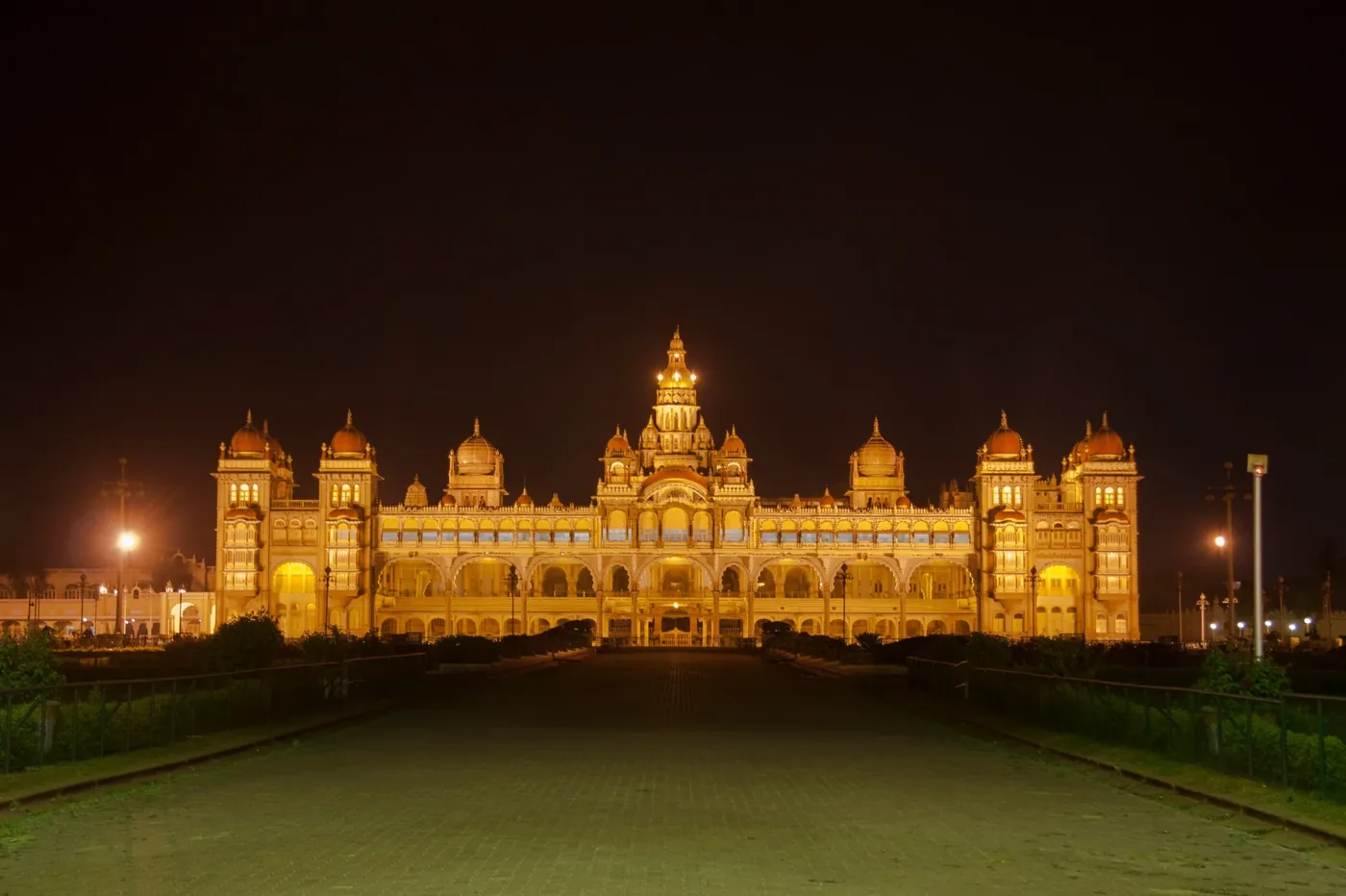
Later, the focus shifts. The Jaganmohan Palace Art Gallery — once the home of the Mysore Maharajas, this royal building now houses a remarkable collection of paintings by famous Indian and international artists, including works by Raja Ravi Varma. Post lunch, return to the hotel and rest for the afternoon. Evening: explore the local market — browse Mysore's famous silk sarees, sandalwood products, incense and handicrafts. Witness the spectacular illumination of Mysore Palace in the evenings — over 97,000 light bulbs transform the palace into a golden spectacle.
For “Mysore Sightseeing — Palaces, Temples & Art”, the sequence follows light, opening hours and local traffic, prioritising the principal visit while keeping secondary stops adaptable.
Overnight: Mysore
As the light softens, the day changes pace. Evening at leisure — stroll through the charming town centre of Ooty. The local market for Ooty's famous homemade chocolates, eucalyptus oil, tea varieties and fresh produce.
The move described in “Mysore to Ooty — Queen of Hill Stations” is scheduled as part of the experience, with a realistic departure and enough margin for an unhurried arrival.
Overnight: Ooty
Begin in the cooler morning hours. Meet your driver and begin sightseeing in Ooty. The Government Botanical Garden — one of Ooty's must-see attractions, home to over 1,000 species of indigenous and exotic plants and trees, including a fossilised tree trunk believed to be over 20 million years old.
Later, the focus shifts. Post lunch, drive to Elk Hill Murugan Temple — perched on a small hill, this temple features a striking statue of Lord Murugan that bears a remarkable resemblance to the famous statue at Batu Caves in Malaysia. Enjoy the afternoon at Ooty Lake — one of the most popular attractions in Ooty; try boating on the picturesque lake surrounded by eucalyptus trees and rolling hills. Evening dinner at one of the popular restaurants in Ooty.
For “Ooty Sightseeing — Peaks, Gardens & Tea”, the sequence follows light, opening hours and local traffic, prioritising the principal visit while keeping secondary stops adaptable.
Overnight: Ooty
In time, transfer to Ooty Railway Station to board the Heritage Toy Train to Mettupalayam. Train details: #061–7 / Ooty3Mettupalayam Special. Timings: Departs Ooty (UAM) at 14:00 hrs and arrives Mettupalayam (MTP) at 17:30 hrs. The train descends through lush forests, tea gardens, tunnels and bridges — a truly unforgettable journey. Note: Your driver will drop you at the station and pick you up at Mettupalayam — carry only essential items for the train journey; leave remaining luggage in the vehicle.
Meet your driver at Mettupalayam station after the train arrives. Coimbatore is a pleasant city with excellent dining options — enjoy dinner at a popular local restaurant.
The move described in “Ooty to Mettupalayam via Heritage Toy Train — Coimbatore” is scheduled as part of the experience, with a realistic departure and enough margin for an unhurried arrival.
Overnight: Ooty
Later, the focus shifts. Late afternoon: meet your guide for a Heritage Walk through the Fort Kochi area. St Francis Church — India's oldest European church, built by Portuguese Franciscan Friars in 1503; Vasco da Gama was originally buried here. See the iconic Chinese Fishing Nets (Cheena Vala) — enormous cantilevered fishing nets introduced by traders from the court of Kublai Khan, unique to Cochin. Walk past the Nehru Children's Park area and the interesting heritage houses — Koder House, Tower House, Old Harbor Hotel. Fort Immanuel — the bastion of the Portuguese. See the Dutch Cemetery, now managed by the Church of South India.
The move described in “Coimbatore to Cochin — Fort Kochi Heritage Walk” is scheduled as part of the experience, with a realistic departure and enough margin for an unhurried arrival.
Overnight: Cochin
Morning — Mattancherry Heritage Walk is approached as part of Cochin Sightseeing — Mattancherry & Kathakali Performance. The guide adjusts the sequence to access, weather and the amount of time guests wish to spend at the principal stop.
As the light softens, the day changes pace. After the walk, transfer to the auditorium for the magnificent Kathakali dance performance at the Kerala Kathakali Centre. Kathakali is one of the oldest classical dance-drama forms in the world — a spectacular art form combining elaborate facial makeup, ornate costumes, intricate hand gestures (mudras) and expressive eye movements. The dedicated artists at the Kerala Kathakali Centre have devoted over 35 years to their craft — their performance is a mesmerising blend of mythology, drama, live music and soul-stirring singing. Arrive early to watch the fascinating makeup and costume preparation — a ritual in itself.
For “Cochin Sightseeing — Mattancherry & Kathakali Performance”, the sequence follows light, opening hours and local traffic, prioritising the principal visit while keeping secondary stops adaptable.
Overnight: Cochin
Watch local life unfold along the banks — fishermen casting their nets, women washing clothes, children playing, and farmers tending their fields. Pass through narrow canals and open lakes, spotting kingfishers, herons, cormorants and other water birds. Enjoy a delicious Kerala lunch on board — fresh fish curry, rice, coconut-based vegetables and traditional payasam. As evening falls, moor at a quiet spot and watch the spectacular sunset over the backwaters. Enjoy dinner on board and sleep to the gentle lapping of the water. Overnight on board the houseboat.
The move described in “Cochin to Alleppey — Overnight Houseboat Cruise” is scheduled as part of the experience, with a realistic departure and enough margin for an unhurried arrival.
Overnight: Cochin
Begin in the cooler morning hours. Disembark the houseboat and meet your driver for the 4-hour drive to Thekkady. The drive climbs through the Western Ghats — a scenic journey through rubber plantations, spice gardens and mountain forests. Arrive in Thekkady by late afternoon; check in at the hotel and relax.
As the light softens, the day changes pace. Evening: participate in the optional cookery class at the resort — master chefs share the secrets of traditional Kerala cooking. Learn about the magical world of Indian spices — what they are, how to use them, how to combine them and how to savour the special magic they bring to even the most commonplace foods. Discover the art of making Kerala classics such as fish molee, avial, puttu and payasam. Stroll through the resort's spice garden in the evening — identify cardamom, pepper, clove and cinnamon plants.
The move described in “Alleppey to Thekkady — Spice Capital of India” is scheduled as part of the experience, with a realistic departure and enough margin for an unhurried arrival.
Overnight: Thekkady
Begin in the cooler morning hours. Walk through the plantation with a knowledgeable guide — see the raw spices growing on their plants and learn about the cultivation, harvesting and processing of each spice. The Kumily Spice Market — the biggest spice market in the country, which exports spices across the globe; browse and purchase authentic spices, essential oils and herbal products.
Later, the focus shifts. Post lunch, enjoy the boat ride on Periyar Lake — the centrepiece of the Periyar Wildlife Sanctuary, one of India's finest tiger and elephant reserves. The lake was formed by the Mullaperiyar Dam in 1895 and is surrounded by dense tropical forests. Watch the cardamom plantation situated near the lake shore. Spot various wildlife during the boat ride — elephants coming to the water's edge, sambar deer, wild boar, Malabar giant squirrels, langur monkeys and a rich variety of birds including the Malabar pied hornbill and the great Indian hornbill.
For “Thekkady Sightseeing — Spice Plantations & Periyar Lake”, the sequence follows light, opening hours and local traffic, prioritising the principal visit while keeping secondary stops adaptable.
Overnight: Thekkady
Later, the focus shifts. Late afternoon: visit the Mattupetty Dam — more than just a water storage facility, the reservoir (Mattupetty Lake) is a perennial lake that never dries up even in summer. The lake is popular with birds and wild animals that rely on this reservoir; enjoy the serene views of the surrounding tea-covered hills. Indulge in activities organised by the hotel if you wish.
The move described in “Thekkady to Munnar — Queen of Kerala Hill Stations” is scheduled as part of the experience, with a realistic departure and enough margin for an unhurried arrival.
Overnight: Munnar
Set out early for Marayoor, where sandalwood forest, rock shelters and prehistoric burial structures create a very different highland landscape from Munnar’s tea estates. The walk is adjusted to fitness, weather and local access; it is not presented as suitable for every traveller without qualification. A local guide provides archaeological and cultural context while protecting fragile sites from unnecessary handling or crowding.
Walk through a working tea estate and visit a factory or museum when production schedules allow. The visit follows the process from leaf selection through withering, rolling, oxidation, drying and grading, followed by a short tasting. The afternoon remains flexible for rest, a plantation walk or resort activities rather than filling every hour of a long itinerary.
For “Munnar Sightseeing — Dolmen's Trek & Tea Plantations”, the sequence follows light, opening hours and local traffic, prioritising the principal visit while keeping secondary stops adaptable.
Overnight: Munnar
As the light softens, the day changes pace. Walk through East Chithirai Street, leading out from the temple into the vibrant bazaars of the city. Meander through small streets passing the tailor's market, vegetable market, banana market, flower market and many specialty shops. The walk ends at the Thirumalai Nayakar Palace — see the beautiful entrance gate, the main hall and the dance hall of this 17th-century Nayaka palace. After the walk, taste Madurai's legendary street food delights — the city is as famous for its food as for its temples; try the iconic Jigarthanda, Kari Dosa and Madurai Mutton Biryani.
The move described in “Munnar to Madurai — City of the Meenakshi Temple” is scheduled as part of the experience, with a realistic departure and enough margin for an unhurried arrival.
Overnight: Madurai
As the light softens, the day changes pace. Evening: visit the weekly market called "Vaara Sabdhai" — a vibrant open-air market where greengrocers, fisherfolk and fruit vendors display their wares under colourful canopies. Browse the stalls for fresh local produce, traditional snacks and Chettinad specialities. Later in the evening, enjoy a classical music concert as an accompaniment to your dinner — a traditional Chettinad cultural experience.
The move described in “Madurai to Chettinad — Land of Mansions & Cuisine” is scheduled as part of the experience, with a realistic departure and enough margin for an unhurried arrival.
Overnight: Madurai
Begin in the cooler morning hours. Watch the skilled artisans at work — each tile is a unique piece of art, and you can purchase tiles and pottery directly from the craftsmen. From Athangudi, drive 30 minutes to visit Thirumayam Fort — built in the 17th century, this fort has been the site of several battles and intrigues; it features a rock-cut cave temple and a hilltop fort with panoramic views. The small town of Kanadukathan — famous for its grand old-style mansions with elaborate woodwork, terracotta and tile work.
Later, the focus shifts. After lunch, visit the antiques market in Karaikudi — browse for Chettinad antiques, old furniture, bronze idols, vintage tiles and collectibles. The local weaving units which produce the famous Chettinad weaves — distinctive handloom cotton sarees with bold geometric patterns. Return to the Mansion and relax for the day.
For “Chettinad Sightseeing — Tiles, Mansions & Markets”, the sequence follows light, opening hours and local traffic, prioritising the principal visit while keeping secondary stops adaptable.
Overnight: Confirmed with the final routing
Leave Chettinad after breakfast and travel towards Pondicherry with two substantial heritage pauses. In Trichy, visit the Rock Fort complex if the climb suits the group, and continue to the Sri Ranganathaswamy temple precinct at Srirangam with appropriate dress and access guidance. In Thanjavur, focus on the Brihadisvara Temple before resuming the road journey, rather than attempting every monument in one day.
Later, the focus shifts. Post lunch, continue the drive to Pondicherry. Arrive in Pondicherry by early evening; check in at the hotel. Pondicherry was a quiet fishing village that passed through the hands of several empires — the Pallavas, Cholas and Vijayanagara kings; beginning in the 1600s, the French developed it into a trading port. Today, Pondicherry is a charming, laid-back seaside town with a unique Franco-Tamil culture — divided into a French Quarter and a Tamil Quarter, each with its own distinctive character, beautiful architecture and delicious cuisine. Retire for the day; overnight at the hotel in Pondicherry.
The move described in “Chettinad to Pondicherry — via Trichy & Thanjavur” is scheduled as part of the experience, with a realistic departure and enough margin for an unhurried arrival.
Overnight: Pondicherry
Full Day — Auroville (City of Dawn) is approached as part of Pondicherry Sightseeing — Auroville & French Quarter. The guide adjusts the sequence to access, weather and the amount of time guests wish to spend at the principal stop.
Evening — French Quarter Heritage Walk is approached as part of Pondicherry Sightseeing — Auroville & French Quarter. The guide adjusts the sequence to access, weather and the amount of time guests wish to spend at the principal stop.
For “Pondicherry Sightseeing — Auroville & French Quarter”, the sequence follows light, opening hours and local traffic, prioritising the principal visit while keeping secondary stops adaptable.
Overnight: Pondicherry
Begin in the cooler morning hours. In Kanchipuram, visit Ekambareswar Temple — a massive temple complex dedicated to Lord Shiva, that gets its name from an ancient mango tree living within its boundaries; one of the Pancha Bhuta Stalas representing the element of Earth. Kamakshi Amman Temple — a magnificent temple dedicated to the goddess Kamakshi, the chief deity of Kanchipuram and one of the three most sacred Shakti shrines in India. Tour a silk loom workshop — watch the intricate process of weaving Kanchipuram's world-famous silk sarees, with their distinctive zari borders and rich colours.
Later, the focus shifts. The Shore Temple — one of the oldest structural stone temples in South India, built by the Pallava king Narasimhavarman II in the 8th century; it stands dramatically at the water's edge. See Arjuna's Penance — one of the largest open-air rock reliefs in the world, depicting scenes from the Mahabharata carved on two massive boulders. Pancha Rathas (Five Chariots) — five monolithic pyramid structures, each carved from a single piece of granite, representing different styles of Dravidian temple architecture. Continue drive to Chennai; arrive at the hotel by late evening.
The move described in “Pondicherry to Chennai — via Kanchipuram & Mahabalipuram” is scheduled as part of the experience, with a realistic departure and enough margin for an unhurried arrival.
Overnight: Chennai
Morning — Colonial Heritage Trail is approached as part of Chennai Sightseeing — Marina, Fort & Mylapore. The guide adjusts the sequence to access, weather and the amount of time guests wish to spend at the principal stop.
Afternoon — Marina Promenade & Mylapore Walk is approached as part of Chennai Sightseeing — Marina, Fort & Mylapore. The guide adjusts the sequence to access, weather and the amount of time guests wish to spend at the principal stop.
For “Chennai Sightseeing — Marina, Fort & Mylapore”, the sequence follows light, opening hours and local traffic, prioritising the principal visit while keeping secondary stops adaptable.
Overnight: Chennai
Begin in the cooler morning hours. Enjoy your final breakfast at the hotel in Chennai. Spend any remaining time exploring the charming streets of Mylapore or browsing the local markets for last-minute souvenirs — Kanchipuram silk sarees, bronze idols, sandalwood products, spices and handloom textiles make wonderful gifts. In time, transfer to Chennai International Airport for your onward flight. Your private transfer concludes the journey at the airport.
22 days of extraordinary experiences across three magnificent states — Karnataka, Kerala and Tamil Nadu. Royal palaces and garden cities of Bangalore and Mysore. The legendary Nilgiri Toy Train through mountain mist. Serene backwater cruises and spice-scented forests of Kerala. Ancient Dravidian temples, Chettinad mansions and the French Quarter of Pondicherry. The warmth of South India's people, the richness of its cuisine and the depth of its culture — memories that will last a lifetime.
For “Depart Chennai — Farewell South India”, the closing day protects the flight connection with a realistic transfer margin and no unnecessary programme added before departure.
Departure / onward journey
Characterful hotels in the great southern cities place architecture, food and neighbourhood life close at hand.
Tea, spice and forest landscapes are best held by quieter properties with views, warmth and thoughtful local hosting.
A considered boat, lakeside retreat or coastal stay gives the long route a slower and restorative final movement.
Hotel names and room categories for Grand South India Tour are confirmed after your dates, preferred character, budget and current availability are understood.
Adjust Grand South India Tour with an extra recovery night, a shorter road day or a gentler start where the route and your energy benefit.
For Grand South India Tour, choose among the stay characters described above, then set room category and service level around how you expect to use the hotel.
For Grand South India Tour, add an architectural specialist, kitchen visit, textile or craft encounter, private boat, Ayurveda consultation or a quieter coastal extension.
For Grand South India Tour, for November to March for the most balanced conditions across all three states, we refine sightseeing hours, transfer starts and access around heat, rain, winter conditions, crowds and local operating days.
Epic Indian Travel Concierge
Tell us which chapter of Grand South India Tour matters most and where you would prefer more time, privacy or specialist depth.